BTS’s V Responds to Being Used as “Evidence” in ILLIT Plagiarism Controversy

The K-pop industry has long experienced creative disputes, but the recent conflict involving
ILLIT and
NewJeans has intensified public discussion. The controversy began when ADOR’s CEO,
Min Hee-jin, alleged that ILLIT’s concept bore similarities to that of NewJeans, suggesting elements of copying.
As legal proceedings unfolded in the dispute between Min Hee Jin and HYBE, new details surfaced. The court examined Min’s claim that raising plagiarism concerns did not constitute a breach of trust. According to the ruling, her statements were interpreted as subjective opinion—focused on overall impression rather than specific, provable factual duplication. In other words, the court categorized the remarks as value judgments rather than concrete accusations of factual plagiarism.
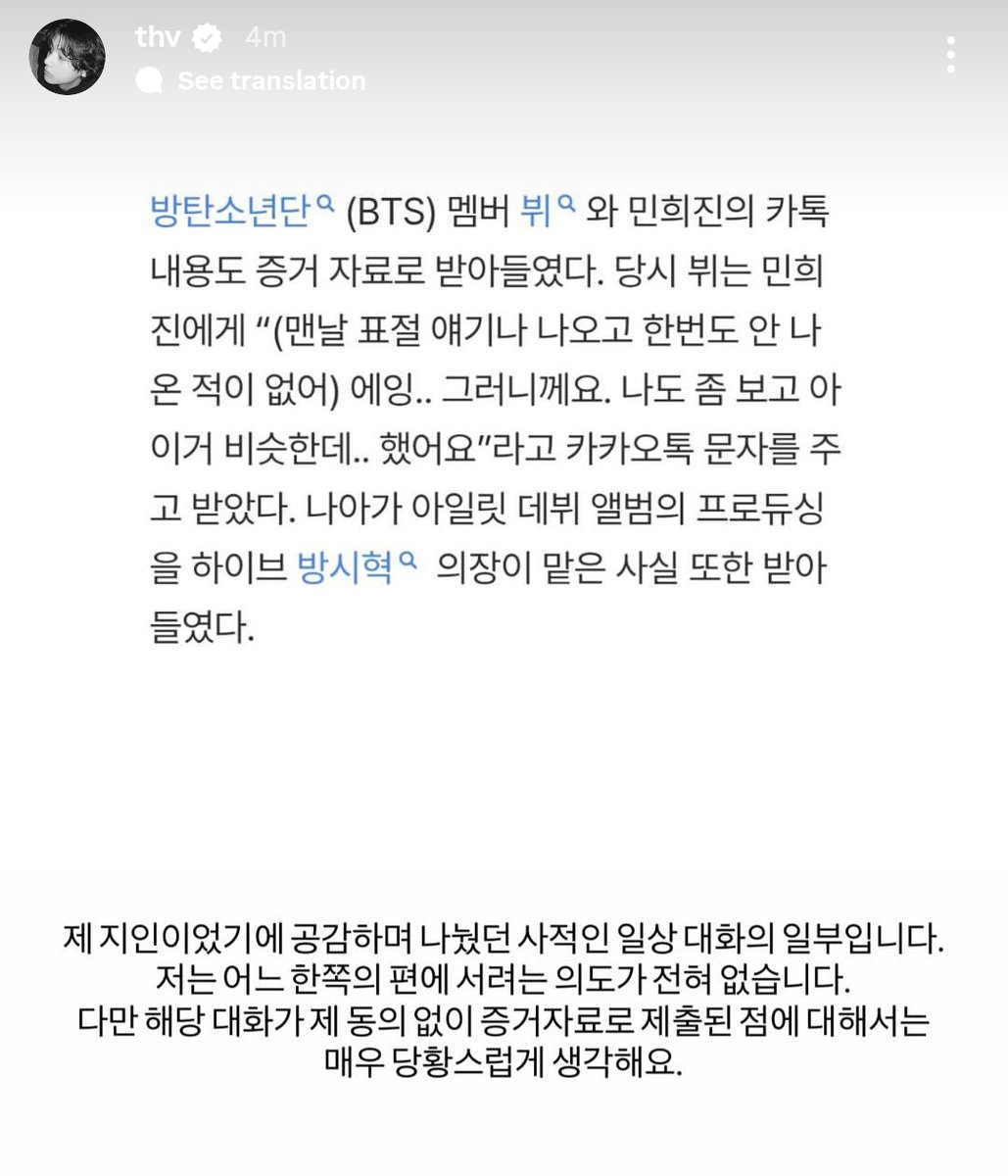
During the case, private KakaoTalk messages between Min Hee Jin and Kim Tae-hyung (V of BTS) were submitted as part of the materials reviewed. In those exchanges, V reportedly commented that plagiarism discussions are common in the industry and acknowledged that, upon seeing the comparisons himself, he also felt certain aspects appeared similar.
Although V of BTS was not a direct participant in the dispute, his remarks became notable within the court’s documentation. The situation drew further attention because HYBE chairman Bang Si-hyuk had been involved in producing ILLIT’s debut, framing the disagreement as an internal conflict within HYBE’s affiliated structure rather than an issue involving outside parties.
After media coverage highlighted the inclusion of his messages, V addressed the matter publicly via Instagram Stories. He clarified that the conversation had been private and shared casually with someone he knew, expressing empathy rather than siding with any argument. He also stated that he was surprised and uncomfortable that the exchange had been used as court evidence without his permission.
HYBE later commented to Korean media outlet OSEN, explaining that the conversation was informal and not intended as endorsement of any specific claim. The company added that the artist was dissatisfied that a personal exchange had been submitted in legal proceedings without prior consent.
HYBE has since filed an appeal, leaving the possibility of further developments as the case continues.